


GHRP-2 vs GHRP-6: Key Differences Explained
GHRP-2 and GHRP-6 are both growth hormone releasing peptides — ghrelin-mimicking secretagogues that prompt the pituitary gland to release a pulse of growth hormone. The practical difference comes down to two things: how strongly each drives GH and how much hunger it triggers. This research-focused guide breaks down the mechanism, the head-to-head profile, stacking with CJC-1295, dosing concepts, and side effects.
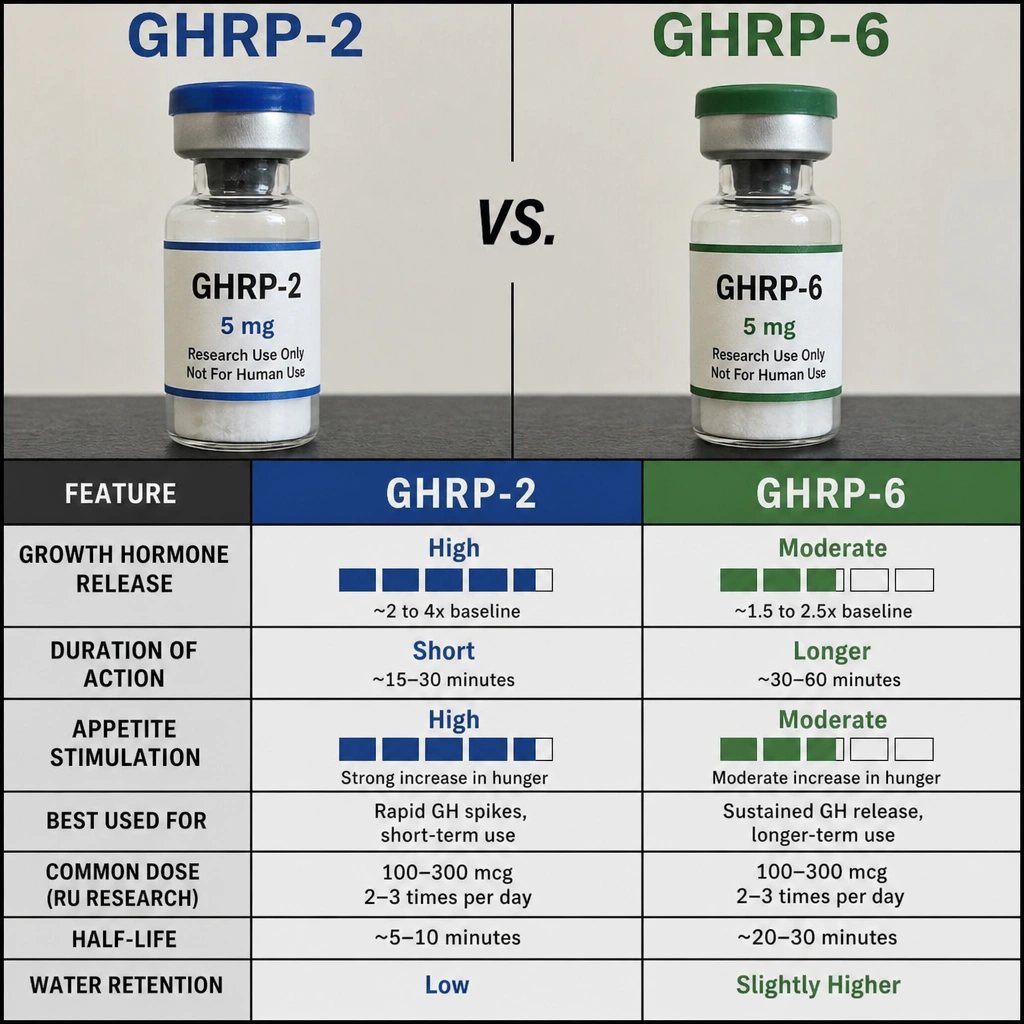
Editorial & research disclaimer: This article is for educational purposes only and is not medical advice. GHRP-2 and GHRP-6 are research chemicals and compounds and research chemicals, not approved medicines, and are not for human consumption in most jurisdictions. Always consult a licensed healthcare professional and verify local regulations before handling any peptide.

Quick Answer
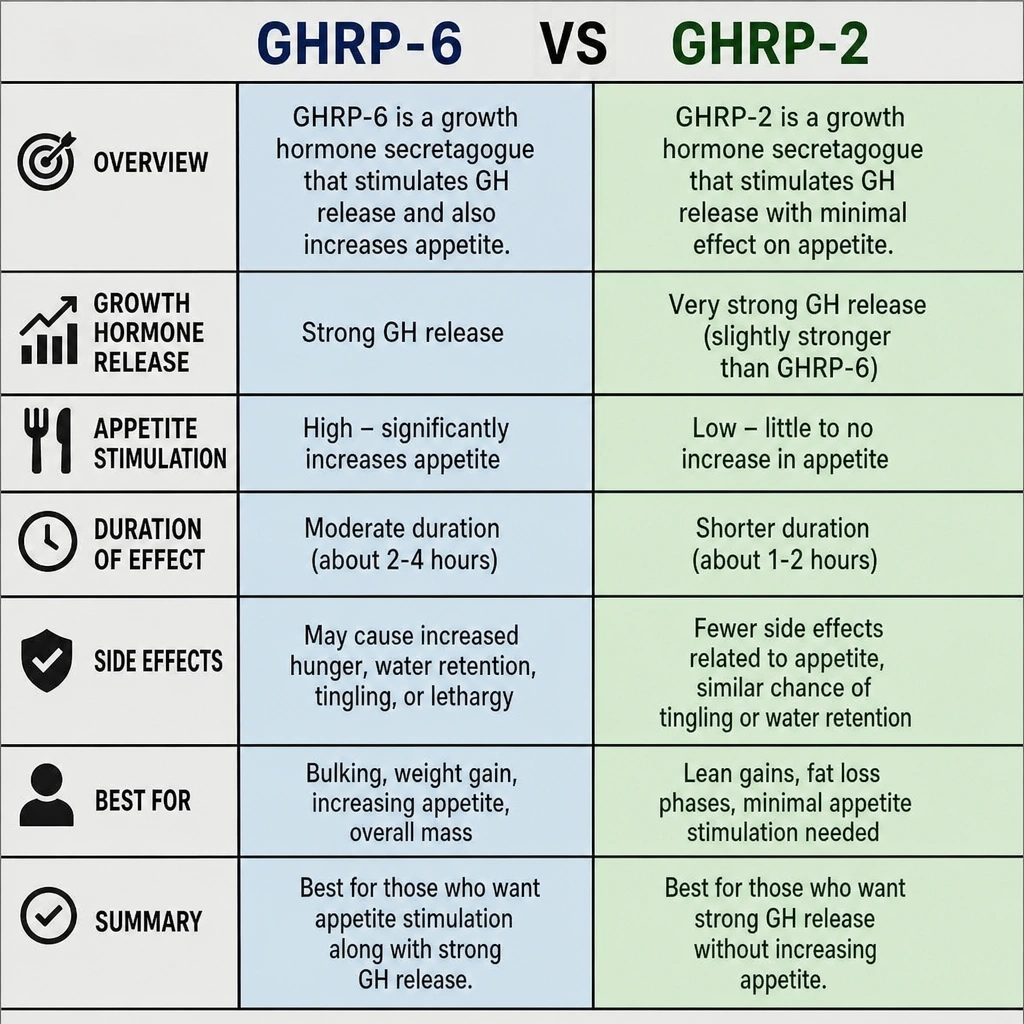
GHRP-2 vs GHRP-6 in one line: both are growth hormone releasing peptides that act on the GHS receptor like ghrelin, but growth hormone-releasing peptide-2 is the more potent GH releaser with less hunger, while GHRP-6 causes pronounced appetite stimulation alongside its GH pulse. Choice in a research setting depends on whether appetite is a desired effect or a nuisance.
Both are research-only compounds. They are frequently studied alongside a GHRH analog, such as sermorelin, tesamorelin, or growth hormone-releasing hormone, because the two classes act through different pathways and produce a larger combined GH pulse.
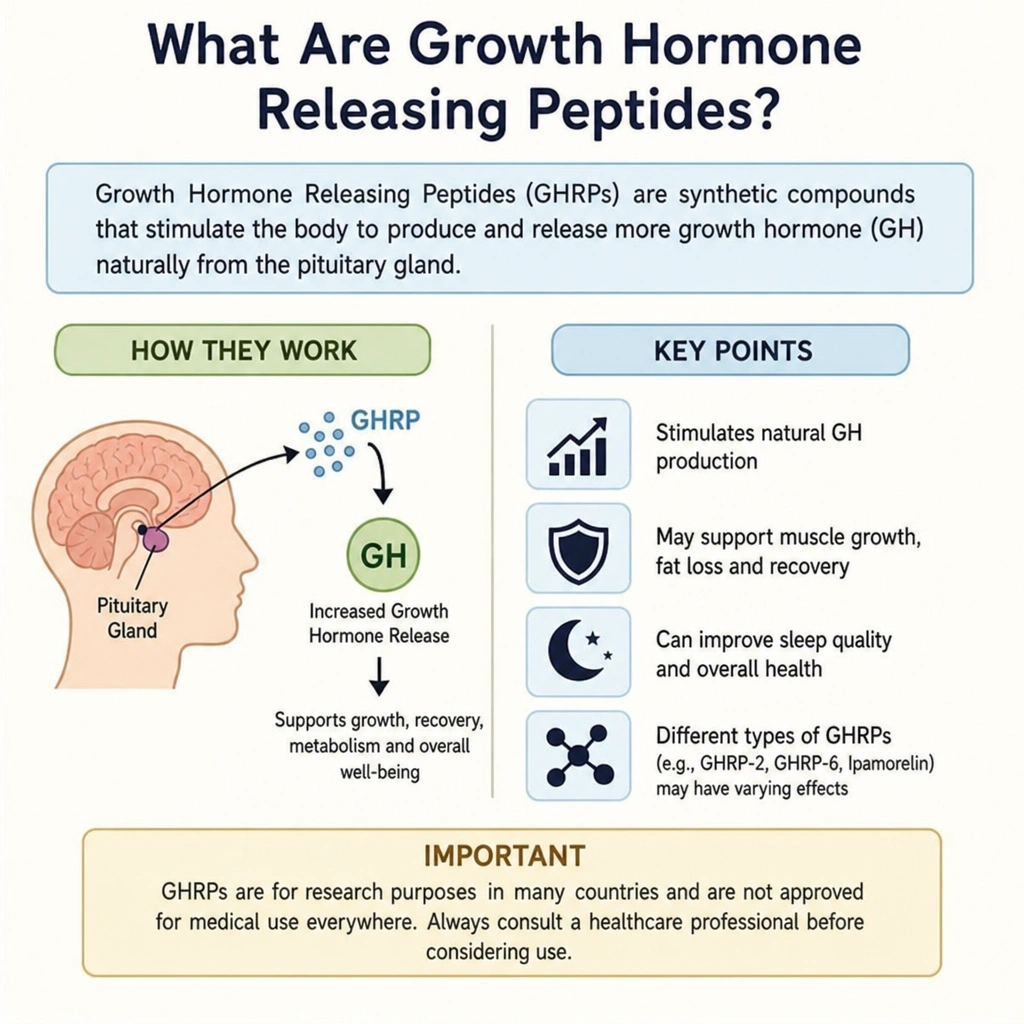
Both are ghrelin-mimetic GH secretagogues acting on the GHS-R, or growth hormone secretagogue receptor, to trigger a pituitary GH pulse.
GHRP-2: stronger GH release, comparatively modest hunger — favored when appetite is unwanted.
GHRP-6: strong appetite stimulation via ghrelin signaling — this growth hormone-releasing peptide-6 is relevant when increased food intake is a goal.
Synergy: GHRPs are commonly paired with CJC-1295 (a GHRH analog) for a larger, more natural GH pulse.
Research only: not approved drugs; dosing concepts here are research parameters, not medical guidance.
What Are Growth Hormone Releasing Peptides?
Growth hormone releasing peptides (GHRPs) are a class of small synthetic peptides that mimic ghrelin, the body's “hunger hormone,” at the growth hormone secretagogue receptor (GHS-R) in the pituitary gland and hypothalamus. By activating this receptor, they prompt the anterior pituitary somatotrophs to release a pulse of the body's own growth hormone, which subsequentlyinfluences systemic insulin-like growth factor 1 (IGF-1) levels, rather than introducing synthetic GH from outside.
That distinction matters: GHRPs work upstream, encouraging endogenous, pulsatile GH release that preserves the body's feedback loops, whereas injecting recombinant HGH supplies the hormone directly and overrides them. GHRP-2 and GHRP-6 are two of the most studied members of this family.
Core Mechanism and Pituitary Response
When a GHRP binds the GHS-R1a, it stimulates GH release and also suppresses somatostatin (the hormone that normally brakes GH). Because they mimic ghrelin, GHRPs can additionally influence appetite and, at higher doses, modestly raise cortisol and prolactin. The degree of each effect is what separates the individual peptides.
The GHRP-6 Profile
GHRP-6 is the classic appetite-stimulating GHRP and synthetic hexapeptide, often compared to hexarelin in potency studies. Its strong ghrelin-like signaling produces a marked increase in hunger, which can be useful in research contexts focused on intake or tissue repair but unwelcome for body-composition goals like lipolysis and muscle growth or hypertrophy. Its GH-releasing potency is solid but generally considered lower than GHRP-2 at comparable doses.
The GHRP-2 Profile
GHRP-2 is regarded as a more potent GH releaser with comparatively less appetite stimulation than GHRP-6 — though it is not appetite-free. It can also nudge ACTH, cortisol, and prolactin upward at higher doses. For research focused on maximizing the GH pulse, growth hormone deficiency, anti-aging, and potential reduction of visceral fat, lean muscle preservation, fat loss, or fat metabolism improvements without driving large food intake, GHRP-2 is typically the more relevant choice.
GHRP-2 vs GHRP-6: Head-to-Head
| Factor | GHRP-2 | GHRP-6 |
|---|---|---|
| GH-releasing potency | Higher | Moderate |
| Appetite stimulation | Mild–moderate | Strong (pronounced hunger) |
| Cortisol / prolactin | Slight rise at high doses | Slight rise at high doses |
| Typical research use | Maximize GH pulse | Appetite / recovery research |
| Half-life | Short (minutes) | Short (minutes) |
| Common pairing | CJC-1295 (GHRH analog) | CJC-1295 (GHRH analog) |
Neither is strictly “better” — they answer different research questions. If unwanted hunger is a problem, GHRP-2 is usually preferred; if increased intake is part of the design, GHRP-6 fits.
The Power of Synergy: Stacking with CJC-1295
GHRPs are frequently studied alongside a GHRH analog such as CJC-1295 (often the non-DAC “mod GRF 1-29” form) or tesamorelin. The two act through different receptors: the GHRH analog amplifies the amount of GH released, while the GHRP triggers and sharpens the pulse and suppresses somatostatin. Combined, they tend to produce a larger, more physiological GH pulse than either alone—often studied for its impact on sleep quality—which is why the pairing is so common in the literature.
Dosing, Cycling, and Managing Side Effects (Research Context)
Because these are not approved medicines, there is no clinical dosing guidance; the parameters discussed in research literature should be treated as research concepts only. General principles that appear repeatedly:
- Timing matters — GHRPs are typically studied on an empty stomach because food (especially fats/carbs) blunts the GH response.
- Saturation dose — beyond a certain amount, extra peptide adds side effects more than GH; “more” is not better.
- Cycling — research protocols often run defined on/off periods rather than continuous use.
- Side-effect watch — water retention, tingling, head-rush, and (for GHRP-6) strong hunger are commonly reported in research notes.
- Use a [reconstitution calculator](https://prymalab.net/peptide-calculator/) to handle research solutions accurately.
How to Buy GHRP-2 and GHRP-6 Safely
As with any research peptide, source on documentation: a batch-specific COA showing 99%+ HPLC purity, identity confirmation, independent third-party testing, cleanroom lyophilization, and cold-chain shipping. Browse PrymaLab's growth hormone & performance peptides as a reference for those transparency standards.
Researching GH secretagogues? Source verified material.
PrymaLab publishes transparent, batch-specific COAs and ships cold-chain so your research peptides are exactly what the label says.
Explore GH & Performance PeptidesFrequently Asked Questions
What is the main difference between GHRP-2 and GHRP-6?
Both are ghrelin-mimicking growth hormone releasing peptides, but GHRP-2 is the more potent GH releaser with comparatively mild appetite stimulation, while GHRP-6 causes pronounced hunger alongside its GH pulse. In research, GHRP-2 is favored when appetite is unwanted and GHRP-6 when increased intake is part of the design.
How do GHRP-2 and GHRP-6 differ from synthetic HGH?
GHRPs work upstream: they prompt the pituitary to release the body's own growth hormone in natural pulses and preserve feedback regulation. Synthetic HGH supplies the hormone directly from outside, overriding those feedback loops. GHRPs are research compounds; HGH is a prescription drug.
Why stack GHRPs with CJC-1295 (without DAC)?
GHRPs and the GHRH analog CJC-1295 act through different receptors, so combining them produces a larger, more physiological GH pulse than either alone. The GHRH analog increases the amount of GH released to support protein synthesis while the GHRP triggers the pulse and suppresses somatostatin. The pairing is common throughout the research literature.
Does GHRP-6 always cause hunger?
Strong appetite stimulation is GHRP-6's defining feature because of its ghrelin-like signaling, and most research notes report pronounced hunger shortly after administration. GHRP-2 stimulates appetite far less. If hunger is undesirable in a protocol, GHRP-2 is usually the more suitable choice.
Why are GHRPs taken on an empty stomach?
Food, especially fats and carbohydrates, blunts the growth hormone response to GHRPs. Research protocols therefore typically administer them on an empty stomach and wait before eating. This is a recurring practical detail in the literature, not medical dosing advice.
What side effects are reported with GHRP-2 and GHRP-6?
Commonly noted effects include water retention, tingling, a transient head-rush or flushing, and — especially with GHRP-6 — strong hunger. Higher doses can modestly raise cortisol and prolactin. Because there is limited human trial data, the full profile is not established; these are research compounds only.
Is there a dose where more GHRP stops helping?
Yes. GHRPs reach a saturation point beyond which additional peptide adds side effects more than extra growth hormone. Research notes consistently describe a ceiling dose, so “more is better” does not apply. Exact figures are research parameters, not clinical recommendations.
How do I buy GHRP-2 or GHRP-6 safely?
Buy only from suppliers that publish a batch-specific Certificate of Analysis with 99%+ HPLC purity, identity confirmation, and independent third-party testing, and that ship lyophilized vials cold. Avoid offshore listings with missing COAs or extreme discounts. These remain research-use-only compounds.
References & Further Reading
- Bowers, C.Y. (1998). Growth hormone-releasing peptide (GHRP). Cellular and Molecular Life Sciences, 54(12), 1316–1329.
- Kojima, M., et al. (1999). Ghrelin is a growth-hormone-releasing acylated peptide from stomach. Nature, 402, 656–660.
- Sigalos, J.T., & Pastuszak, A.W. (2018). The Safety and Efficacy of Growth Hormone Secretagogues. Sexual Medicine Reviews, 6(1), 45–53.
- Raun, K., et al. (1998). Ipamorelin and GHRP analog pharmacology. European Journal of Endocrinology.
- U.S. Food and Drug Administration. Compounding and the FDA: Questions and Answers. FDA.gov. Accessed 2026.
PrymaLab resources: Bioregulator peptides · Research Hub · Peptide calculator · FAQ · About PrymaLab.
Final disclaimer: This article is for educational purposes only. GHRP-2 and GHRP-6 and the other compounds discussed are sold for research purposes only and are not approved by the FDA or comparable agencies for human therapeutic use. Statements about their effects have not been evaluated by the FDA.
Always consult a licensed healthcare professional before starting any new health protocol, and verify the legal status of any compound in your jurisdiction. PrymaLab does not endorse any specific third-party peptide vendor mentioned in this article and assumes no responsibility for third-party products.